
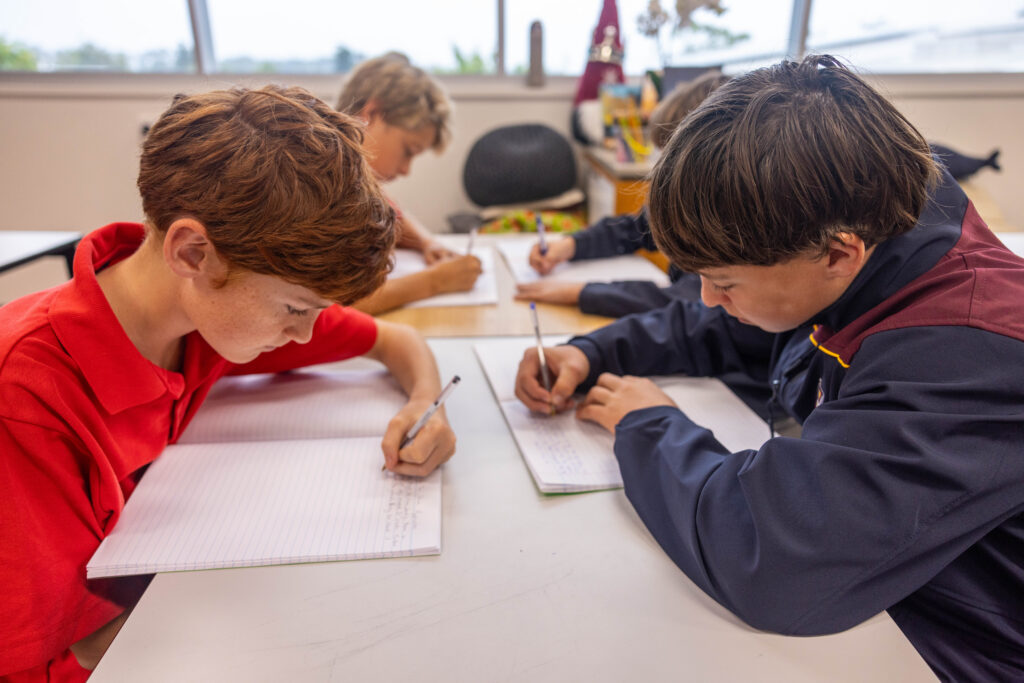
The value and importance of handwriting is complex and multifaceted.
Each Christmas I handwrite a letter to my 94-year-old aunt in the UK who has admirably avoided being drawn into any form of electronic communication.
It’s letters and cards all the way with her. A pleasant task, but one that over recent years has left me with an increasingly aching hand. This feeling will not be uncommon to adults reading this who were once able to write fluently by hand in their youth, negotiating handwritten essays and exams without a second thought. The fact is, in adult life most of us simply do not handwrite and thus our skills and stamina in this domain have atrophied. This may seem an unusual opening to this article given its title and the arguments I will make for the importance of handwriting for our boys; however, I strongly believe that a continued focus on handwriting for students is vital. The value and importance of handwriting is complex and multifaceted.
In an era where digital devices are ubiquitous, most educational institutions, including Scotch, have pivoted to delivering programmes and large parts of our pedagogy via digital devices. We must prepare our students for the world beyond school, and the future is undoubtedly digital. The introduction of large language model AI, and teaching boys how to most effectively use this powerful new technology, is also a key focus; however, the danger of an over-reliance on AI is that boys will outsource the thinking process, and these shortcuts will detract from their cognitive development.
While technologies such as AI offer speed and convenience, there is now overwhelming evidence from educational practice and research that indicates handwriting is more than an outdated practice; it is a highly valuable cognitive tool that supports memory, thinking and academic performance. At Scotch, we are committed to the maintenance and development of handwriting skills from the Early Learning Centre all the way through to Year 12, and below are three key findings from recent educational research that explain why:
Handwriting and memory retention
One of the most compelling reasons for prioritising handwriting in schools is its unique impact on the brain’s learning processes. In an Italian study from 2025, The Neuroscience Behind Writing: Handwriting vs. Typing—Who Wins the Battle?, researchers found that handwriting activates a broader network of brain areas involved in motor, sensory, and cognitive processing, leading to deeper engagement with material and enhanced memory retention compared with typing. Similarly, research in Norway recorded brain activity in 36 university students and showed that handwriting activates far more elaborate connectivity patterns than typing – a difference linked to stronger memory formation.
Handwriting and academic success
In our Junior School, extensive time and effort are devoted to developing each boy’s handwriting skills to ‘automate’ transcription. When transcription, referring to the physical act of writing, is automatic, learners can focus on idea generation and expression rather than struggling with letter formation. Proficiency isn’t about neatness; it directly influences academic outcomes.
Research demonstrates that students who can write fluently and legibly are better positioned to demonstrate their knowledge in tests, assessments and handwritten exams. Despite the gradual move to online assessment for NAPLAN, in Year 12 all exams remain offline and handwritten, and this will remain the case for the foreseeable future.
Handwriting and study skills
The physical act of forming letters by hand helps develop fine motor control, hand-eye coordination, spatial awareness and attentional focus, all which are foundational skills that benefit academic and everyday tasks. For teenagers, handwriting can also serve as a cognitive organiser. The engagement of pen and paper helps reduce
distraction and creates a mental space for reflection—a contrast to the rapid, often fragmented engagement typical of digital typing. Handwriting’s slower pace encourages students to process information more deliberately, summarise content in their own words and strengthen the neural pathways that support effective study skills.
At Scotch, we assert that maintaining a robust handwriting programme is not merely nostalgic, it is an important educational tool. By valuing handwriting and digital literacies in tandem, we equip students with complementary skills that enhance their understanding, communication and lifelong learning.
Help at home
Whilst at Scotch we prioritise the maintenance and development of handwriting, it is equally important that families reinforce this at home. Making pens and paper available in the house and encouraging writing in everyday life where possible will help. You can even encourage your sons to write Christmas thank-you letters to loved ones!
Mr Richard Spence
Director of Teaching and Learning (PK–12)